The Black Swan Revealed: The True Cause of This Bitcoin Crash

marsbitPublished on 2026-02-08Last updated on 2026-02-08

Abstract

In a detailed analysis, Bitwise CIO Jeff Park explains the true cause behind the recent Bitcoin crash, attributing it to a complex interplay of traditional finance mechanisms rather than crypto-native factors. The initial trigger was a broad-based de-leveraging event within multi-strategy hedge funds, prompted by an extreme down day in software stocks and correlated risk assets—a statistically rare "black swan" event. This forced, indiscriminate selling included Bitcoin exposure, much of which was held in delta-neutral hedged positions like basis trades. The violent unwind then interacted with negative gamma dynamics in the options market. Market makers, who were structurally short gamma due to prior low volatility and client demand for puts, were forced to aggressively sell spot Bitcoin (including the IBIT ETF) as price fell, accelerating the downward move. This created a scenario where dealers effectively shorted into the sell-off, generating new ETF inventory and paradoxically preventing the expected massive outflows. Instead, the ETF complex saw net inflows. The analysis concludes that the crash was not driven by directional bearishness but by hedging and de-risking needs within traditional finance. This integration means that future rallies could be even more violent due to the same structural mechanics, highlighting Bitcoin's maturation within global capital markets.

Author | Jeff Park (CIO of Bitwise)

Compiled by | Odaily Planet Daily (@OdailyChina)

Translator | DingDang (@XiaMiPP)

Editor's Note: On February 5th, the crypto market experienced another sharp decline, with over $2.6 billion in liquidations within 24 hours. Bitcoin briefly crashed to $60,000. However, the market does not seem to have a clear consensus on the cause of this drop. Jeff Park, CIO of Bitwise, offers a new analytical framework from the perspective of options and hedging mechanisms.
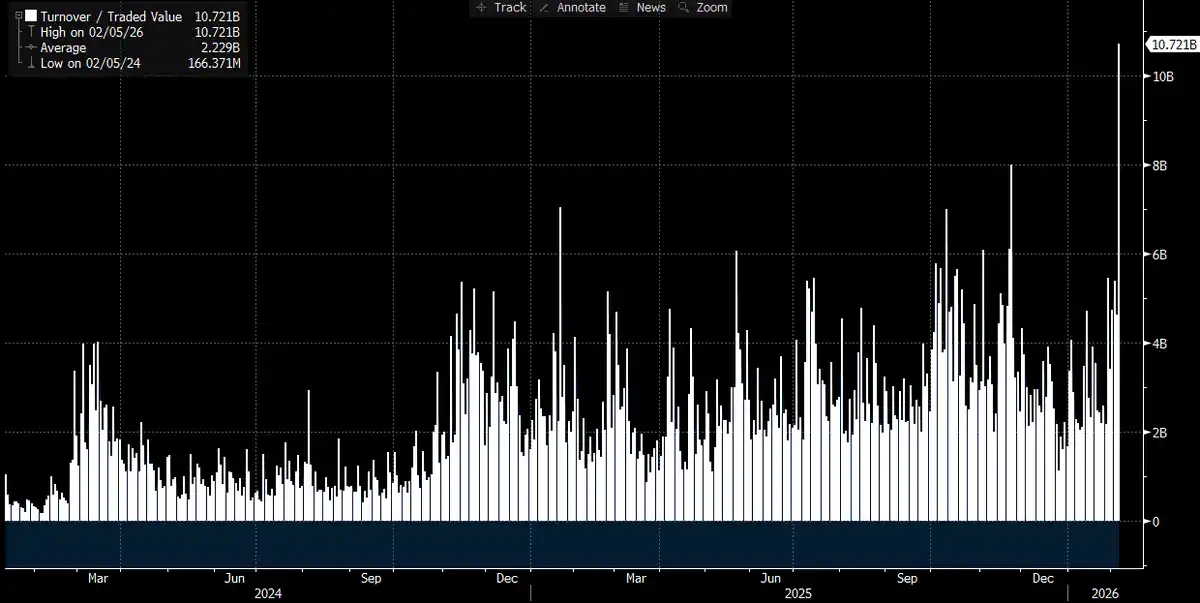
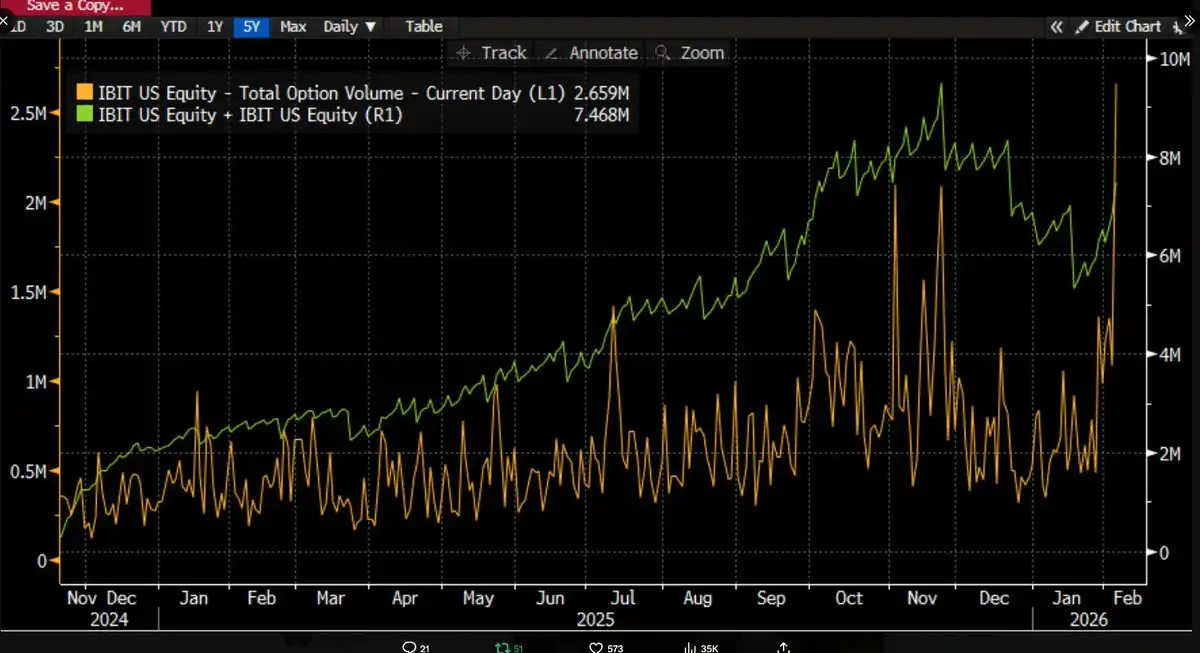
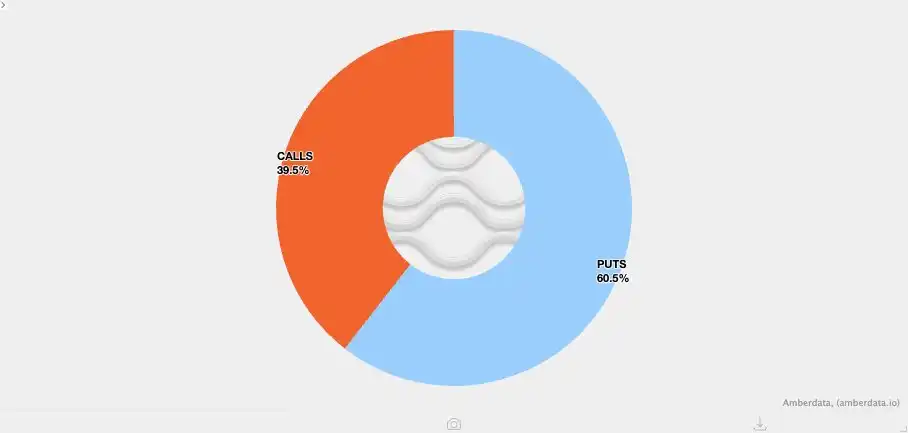
As time passes and more data becomes available, the situation is becoming clearer: this severe sell-off is likely related to the Bitcoin ETF, and the day itself was one of the most volatile trading days in recent capital market history. We can draw this conclusion because IBIT's trading volume hit a record high that day—exceeding $10 billion, double the previous record (a truly staggering number). Simultaneously, options volume also reached a record high (see chart below, showing the highest number of contracts since the ETF's launch). What was somewhat unusual compared to the past was the structure of the volume: this time, options trading was clearly dominated by put options, not call options (we will elaborate on this later).
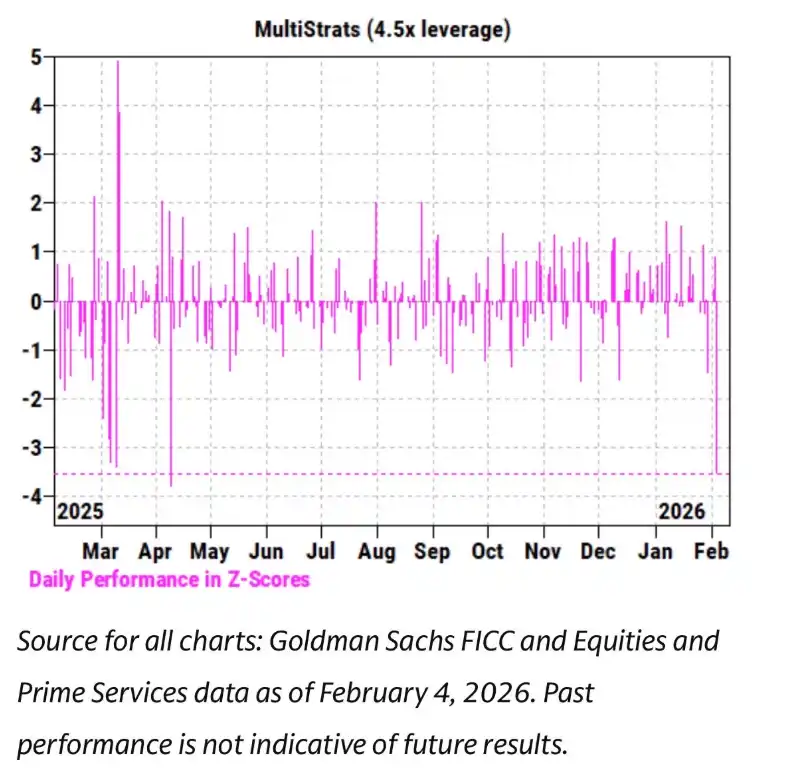
At the same time, over the past few weeks, we have observed that IBIT's price movements have shown an extremely tight correlation with software stocks and other risk assets. Goldman Sachs' Prime Brokerage (PB) team also reported that February 4th was one of the worst single days on record for multi-strategy funds, with a Z-score as high as 3.5. This means it was an extreme event with a probability of only 0.05%, making it 10 times rarer than a 3-sigma event (the classic "black swan" threshold, with a probability of about 0.27%). It was, one could say, a catastrophic shock. It is typically after such events that risk managers at multi-strategy funds (pod shops) quickly step in, demanding all trading teams immediately, indiscriminately, and urgently deleverage. This explains why February 5th also turned into a bloodbath.
With so many records broken and a clear downward direction (a 13.2% drop in a single day), we originally expected to very likely see net redemptions from the ETFs. Judging from historical data, this expectation was not far-fetched: for example, on January 30th, after a 5.8% drop the previous trading day, IBIT saw a record redemption of $530 million; or on February 4th, IBIT saw about $370 million in redemptions amid consecutive declines. Therefore, in the market environment of February 5th, expecting at least $500 million to $1 billion in outflows was entirely reasonable.

But the opposite happened—we saw widespread net subscriptions. IBIT added approximately 6 million shares that day, corresponding to an increase in assets under management of over $230 million. Meanwhile, other Bitcoin ETFs also recorded inflows, with the entire ETF system collectively attracting over $300 million in net inflows.

This result is somewhat puzzling. Theoretically, one could勉强conceive that the strong price rebound on February 6th somewhat reduced redemption pressure, but going from "potentially reducing outflows" to "net inflows" is a completely different matter. This implies that multiple factors were likely at play simultaneously, but these factors do not form a single, linear narrative framework. Based on the information we currently have, several reasonable preliminary assumptions can be made, and on top of these, I will present my overall inference.

First, this round of Bitcoin selling likely affected a type of multi-asset portfolio or strategy that is not purely crypto-native. This could be the multi-strategy hedge funds mentioned earlier, or it could be funds like BlackRock's model portfolio business, which allocates between IBIT and IGV (a software ETF) and were forced into automatic rebalancing during the sharp volatility.

Second, the acceleration of the Bitcoin sell-off was likely related to the options market, particularly option structures related to the downside.

Third, this selling did not ultimately translate into capital outflows at the Bitcoin asset level, meaning the main driving force behind the price action came from the "paper money system," i.e., position adjustment behavior dominated by dealers and market makers, overall in a hedged state.

Based on the above facts, my core hypothesis is currently as follows.

  1. The direct catalyst for this sell-off was a broad deleveraging triggered by multi-asset funds and portfolios after the downside correlation of risk assets reached a statistically anomalous level.
  2. This process then triggered an extremely violent deleveraging, which also included Bitcoin exposure, but a significant portion of this risk was actually in "Delta neutral" hedged positions, such as basis trades, relative value trades (e.g., Bitcoin vs. crypto stocks), and other structures where the residual Delta risk is typically "boxed" by the dealer system.
  3. This deleveraging then triggered a negative Gamma effect, further amplifying the downward pressure, thus forcing dealers to sell IBIT. However, because the selling was so fierce, market makers had to go net short Bitcoin regardless of their own inventory. This process, in turn, created new ETF inventory, thereby lowering the market's original expectation of large-scale outflows.

Subsequently, on February 6th, we observed positive inflows into IBIT, as some IBIT buyers (the question is, what type of buyers are these?) chose to allocate on the dip after the decline, further offsetting what might have been a small net outflow.

First, I personally tend to believe that the initial catalytic factor for this event came from the sell-off in software stocks, especially considering the high correlation Bitcoin showed with software stocks, even higher than its correlation with gold. Please refer to the two charts below.
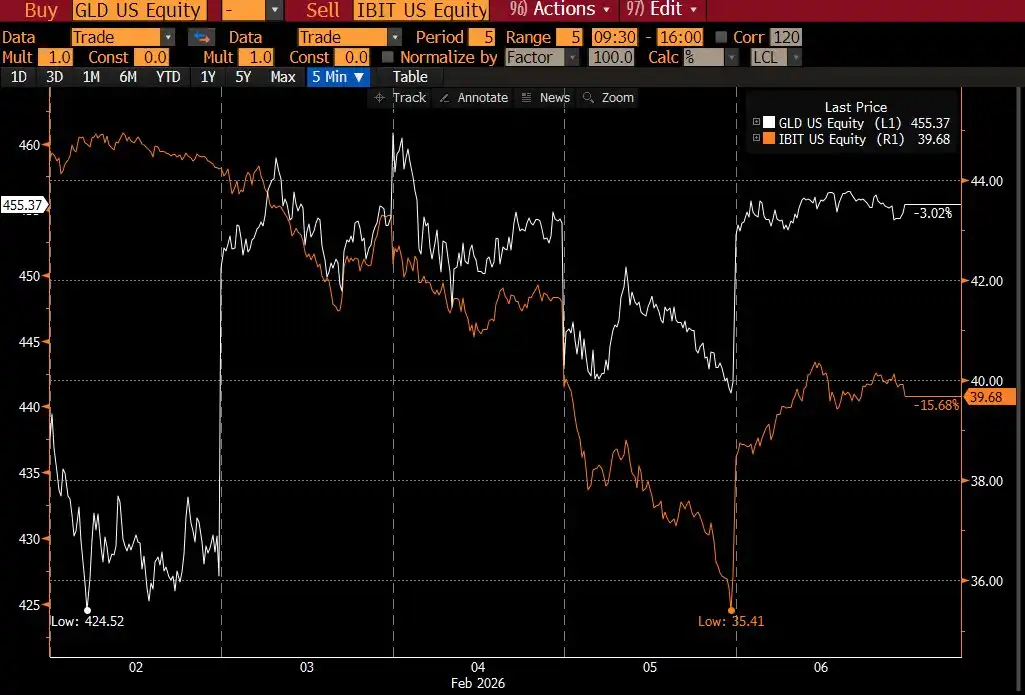
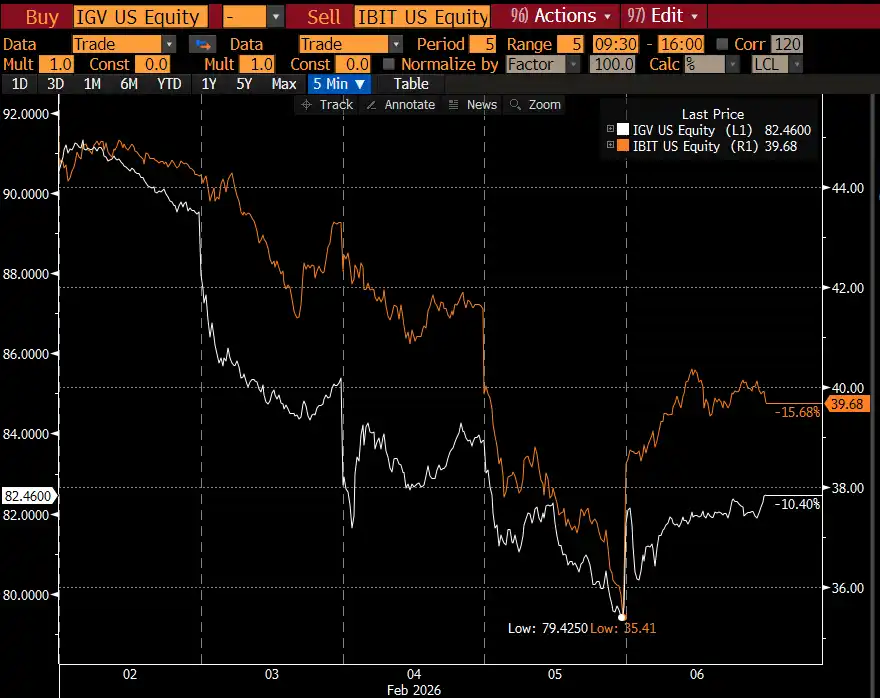
This is logically sound because gold is typically not an asset held in large quantities by multi-strategy funds engaged in financing trades, although it may appear in RIA model portfolios (pre-designed asset allocation plans). Therefore, in my view, this further supports the judgment that: the epicenter of this turmoil is more likely located within the multi-strategy fund system.

This makes the second judgment seem more reasonable as well, namely that this violent deleveraging process did indeed include Bitcoin risk that was in a hedged state. Take the CME Bitcoin basis trade as an example; this has long been one of the most favored trading strategies among multi-strategy funds.

Looking at the complete data from January 26th to yesterday, covering the CME Bitcoin basis movements for 30, 60, 90, and 120-day tenors (thanks to top industry researcher @dlawant for the data), one can clearly see that the near-month basis jumped from 3.3% to as high as 9% on February 5th. This is one of the largest jumps we have personally observed in the market since the ETF launch, which almost unequivocally points to one conclusion: basis trades were forcibly liquidated on a large scale under指令.

Imagine institutions like Millennium, Citadel, being forced to liquidate basis trade positions (selling spot, buying futures). Considering their volume within the Bitcoin ETF system, it's easy to understand why this operation would cause a severe shock to the overall market structure. I have previously written down my own reasoning on this point.

Odaily Planet Daily补充: Currently, a large portion of this undifferentiated selling in the US likely comes from multi-strategy hedge funds. These funds often employ delta hedging strategies, or run some form of relative value (RV) or factor-neutral trades, and these trades are currently widening spreads, possibly accompanied by spillover from growth stock equity correlations.

A rough estimate: About 1/3 of Bitcoin ETF holdings are of the institutional type, and roughly 50% (possibly more) of that is believed to be held by hedge funds. This is a considerable amount of fast money flow, which can easily capitulate and liquidate once financing costs or margin requirements rise in the current high-volatility environment and risk managers intervene, especially when the basis yield is no longer worth the risk premium. It's worth mentioning that MSTR's USD trading volume today is among the highest in its history.

This is why the biggest factor最容易 causing hedge fund failures is the notorious "common holder risk": multiple seemingly independent funds hold highly similar exposures, and when the market turns down, everyone rushes to the same narrow exit simultaneously, causing all downside correlations to tend towards 1. Selling in such poor liquidity conditions is typical "risk-off" behavior, which we are seeing today. This will eventually be reflected in the ETF flow data. If this hypothesis holds, I suspect prices will reprice quickly once this all clears, though rebuilding confidence will still take some time afterwards.

This leads to the third clue. Now that we understand why IBIT was sold amid broad deleveraging, the question becomes: What was accelerating the decline? A possible "accelerant" is structured products. Although I don't believe the structured products market is large enough to trigger this sell-off on its own, when all factors align abnormally and perfectly simultaneously in a way that exceeds any VaR (Value at Risk) model's expectations, they can certainly become the acute event that triggers a chain of liquidations.

This immediately reminds me of my experience working at Morgan Stanley. There, structured products with knock-in put barriers (options that only "activate" and become effective puts if the underlying asset price touches/crosses a specific barrier level) often had devastating consequences. In some cases, the change in option Delta could even exceed 1, a phenomenon not even considered in the Black-Scholes model—because in the standard Black-Scholes framework, for plain vanilla options (the most basic European call/put options), the delta can never exceed 1.

Take a note priced by J.P. Morgan last November as an example; its knock-in barrier was set exactly at 43.6. If these notes continued to be issued in December, and the Bitcoin price fell another 10%, one can imagine a large accumulation of knock-in barriers in the 38–39 range, the so-called "eye of the storm."
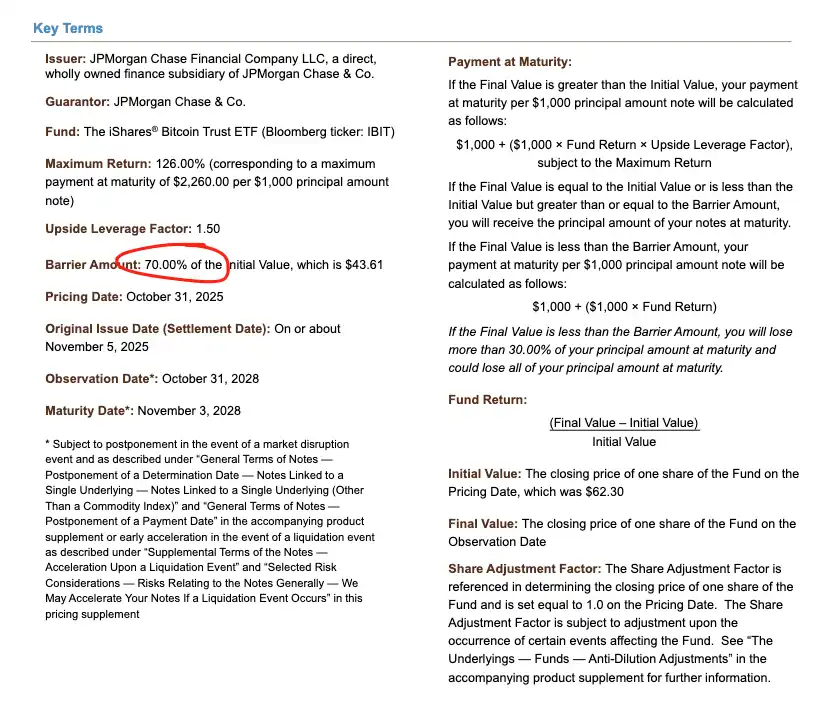
In cases where these barriers are breached, if dealers hedged the knock-in risk by selling put options, etc., the rate of change in Gamma can be extremely rapid under negative Vanna dynamics. At this point, as a dealer, the only viable response is to aggressively sell the underlying asset as the market weakens. This is precisely what we observed: implied volatility (IV) collapsed to near 90%, an extreme historical value, almost reaching a catastrophic squeeze level. In such a situation, dealers were forced to expand their IBIT short positions to the extent that they ultimately created net new ETF shares. This part确实 requires some degree of inference and is difficult to fully confirm without more detailed spread data, but given the record volume that day and the deep involvement of Authorized Participants (APs), this scenario is entirely possible.

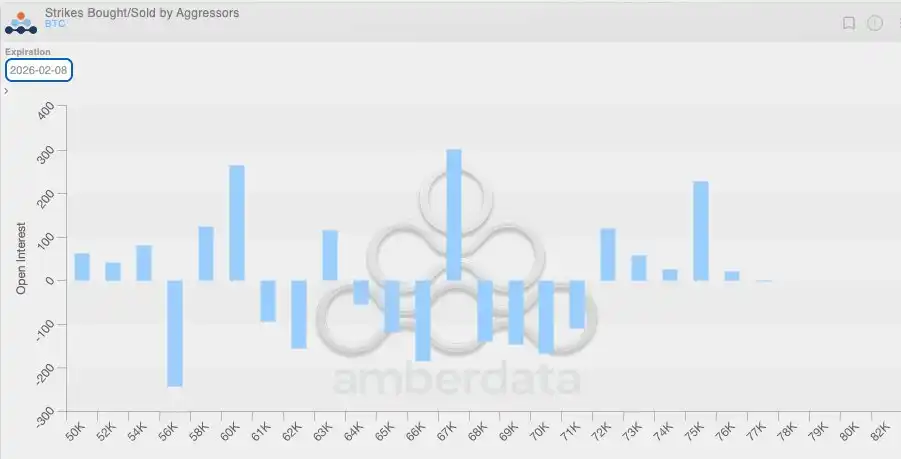
Combining this negative Vanna dynamic with another fact makes the logic even clearer. Due to the overall low volatility in the previous period, crypto-native market clients had generally tended to buy put options over the past few weeks. This means crypto dealers were naturally in a short Gamma state and had underpriced the potential for outsized moves. When the真正的大幅 move occurred, this structural imbalance further amplified the downward pressure. The position distribution chart below also clearly shows this, with dealers concentrated in short Gamma positions on put options in the $64k to $71k range.
This brings us back to February 6th, when Bitcoin staged a strong rebound of over 10%. A notable phenomenon on that day was that the CME's open interest (OI) expanded明显 faster than Binance's (again thanks to @dlawant for aligning the hourly data to 4 PM ET). From February 4th to 5th, a clear collapse in CME OI can be seen, again confirming the judgment that basis trades were liquidated on a large scale on February 5th; on February 6th, these positions were likely re-established to take advantage of higher basis levels, thereby offsetting the impact of outflows.
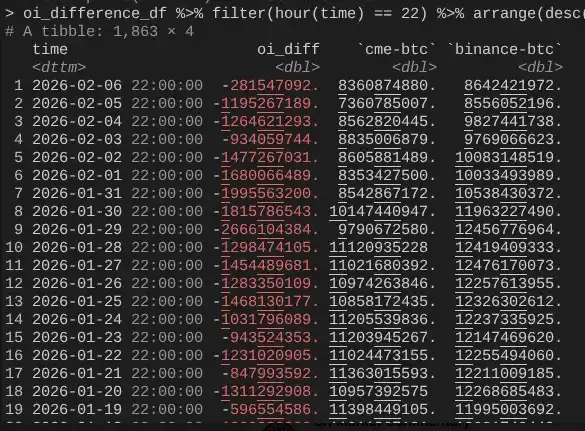
At this point, the entire logical chain closes: IBIT was roughly flat in terms of creations and redemptions because CME basis trades have resumed; but prices remained偏低 because Binance's OI showed a clear collapse, meaning a significant portion of the deleveraging pressure came from short Gamma positions and liquidations within the crypto-native market.

The above is my best explanation for the market performance on February 5th and subsequently on February 6th. This reasoning is built on several assumptions and is not entirely satisfying because it doesn't have a clear "culprit" to blame (like the FTX incident). But the core conclusion is this: The trigger for this sell-off came from de-risking behavior in traditional finance outside crypto, and this process恰好 pushed the Bitcoin price into a range where short Gamma hedging behavior would accelerate the decline. This drop was not driven by directional bearishness but triggered by hedging needs, and ultimately reversed quickly on February 6th (unfortunately, this reversal primarily benefited market-neutral capital in traditional finance, not crypto-native directional strategies). Although this conclusion may not be exciting, it is at least somewhat reassuring to know that the previous day's sell-off likely had nothing to do with a 10/10 event.

Yes, I do not believe what happened last week was a continuation of the 10/10 deleveraging process. I read an article suggesting this turmoil might have originated from a non-US, Hong Kong-based fund involved in a failed JPY carry trade. But this theory has two obvious flaws. First, I don't believe a non-crypto prime broker would be willing to service such a complex multi-asset trade while also providing a 90-day margin buffer, without falling into insolvency first when the risk framework tightened. Second, if the carry trade capital was "bailed out" by buying IBIT options, then the Bitcoin price drop itself would not accelerate the risk release—these options would simply go out-of-the-money, their Greeks quickly decaying to zero. This means the trade itself must have contained real downside risk. If someone is long USD/JPY carry and simultaneously selling IBIT put options, then that prime broker, frankly, does not deserve to exist.

The next few days will be crucial, as we will obtain more data to determine whether investors are using this dip to build new demand. If so, that would be a very bullish signal. For now, I am quite encouraged by the potential ETF inflows. I still firmly believe that true RIA-style ETF buyers (not relative value hedge funds) are savvy investors, and at the institutional level, we are seeing substantial, real, and profound progress, which is evident throughout the industry's advancement and among my friends at Bitwise. For this reason, I am paying close attention to net inflows that are not accompanied by an expansion in basis trading.

Finally, all of this also shows that Bitcoin has integrated into the global financial capital markets in an extremely complex and mature way. This also means that when the market finds itself on the other side of a squeeze in the future, the upward move will be steeper than ever before.

The fragility of traditional finance's margin rules is Bitcoin's antifragility. Once the rebound comes—which I believe is inevitable, especially after Nasdaq raised the options open interest cap—it will be a spectacular sight to behold.

Related Questions

QAccording to the article, what was the primary catalyst for the Bitcoin sell-off on February 5th?

AThe primary catalyst was a broad-based de-leveraging event triggered by multi-strategy hedge funds after risk assets, particularly software stocks, experienced a statistically anomalous level of downside correlation, forcing an indiscriminate and emergency reduction of leverage across all trading books.

QWhy did the Bitcoin ETFs see net inflows instead of the expected outflows on the day of the crash?

AThe sell-off was largely driven by 'paper' flows within the dealer and market-maker system, involving the adjustment of hedged positions like basis trades. The violent selling forced market makers to net short Bitcoin, which paradoxically created new ETF inventory. This, combined with dip-buying from certain investors the next day, offset the expected outflows and resulted in net inflows.

QWhat role did options and 'negative Vanna dynamics' play in accelerating the market decline?

AStructured products with knock-in put barriers and a market structure where dealers were net short gamma (due to clients buying puts in a low-vol environment) created a situation where dealers were forced to aggressively sell the underlying asset (Bitcoin) as the price fell. This negative Vanna dynamic, where gamma changes rapidly, acted as an accelerant to the downward move.

QHow does the article differentiate the nature of this sell-off from a '10/10'-style deleveraging event?

AThe article argues this was not a continuation of a '10/10' event because the initial selling pressure came from de-risking in traditional multi-strategy funds (non-crypto native) and was amplified by hedging mechanics, not from a crypto-native, over-leveraged entity collapsing. The subsequent flows showed the ETF ecosystem was resilient with net inflows, indicating the selling was not driven by directional bearishness on Bitcoin itself.

QWhat is the author's overall conclusion about Bitcoin's integration into traditional finance based on this event?

AThe author concludes that Bitcoin is now deeply and complexly integrated into global capital markets. This means it is susceptible to traditional financial shocks and hedging mechanics, but it also sets the stage for potentially more violent and steep rallies on the way up due to the fragility of traditional margin rules versus Bitcoin's anti-fragility.

Related Reads

Trading

Spot
Futures

Hot Articles

O que é BITCOIN

Compreender o HarryPotterObamaSonic10Inu (ERC-20) e a Sua Posição no Espaço Cripto Nos últimos anos, o mercado de criptomoedas assistiu a um aumento na popularidade das moedas meme, cativando não apenas os traders, mas também aqueles que procuram envolvimento comunitário e valor de entretenimento. Entre estes tokens únicos está o HarryPotterObamaSonic10Inu (ERC-20), um projeto intrigante que mistura referências culturais no tecido das criptomoedas. Este artigo explora os principais aspetos do HarryPotterObamaSonic10Inu, examinando os seus mecanismos, a sua ética orientada pela comunidade e o seu envolvimento com o vasto panorama cripto. O que é o HarryPotterObamaSonic10Inu (ERC-20)? Como o nome sugere, o HarryPotterObamaSonic10Inu é uma moeda meme construída na blockchain Ethereum, classificada sob o padrão ERC-20. Ao contrário das criptomoedas tradicionais, que podem enfatizar a utilidade prática ou o potencial de investimento, este token prospera no valor de entretenimento e na força da sua comunidade. O projeto visa promover um ambiente onde utilizadores envolvidos possam reunir-se, partilhar ideias e participar em atividades inspiradas por diversos fenómenos culturais. Uma característica notável do HarryPotterObamaSonic10Inu é a zero taxa sobre transações. Este elemento atraente visa encorajar a negociação e o envolvimento da comunidade, isento de encargos adicionais que podem desencorajar os traders de pequena escala. A oferta total da moeda está fixada em mil milhões de tokens, uma cifra que marca a sua intenção de manter uma circulação substancial dentro da comunidade. Criador do HarryPotterObamaSonic10Inu (ERC-20) As origens do HarryPotterObamaSonic10Inu estão um pouco envoltas em mistério; os detalhes sobre o criador permanecem desconhecidos. O desenvolvimento deste token carece de uma equipa identificável ou de um plano explícito, o que não é raro no setor das moedas meme. Em vez disso, o projeto surgiu de forma orgânica, com o seu progresso a depender fortemente do entusiasmo e da participação da sua comunidade. Investidores do HarryPotterObamaSonic10Inu (ERC-20) No que diz respeito a investimentos externos e apoios, o HarryPotterObamaSonic10Inu também permanece ambíguo. O token não lista quaisquer fundações de investimento conhecidas ou apoio organizacional significativo. Em vez disso, o “sangue vital” do projeto é a sua comunidade de base, que informa o seu crescimento e sustentabilidade através da ação coletiva e do envolvimento no espaço cripto. Como Funciona o HarryPotterObamaSonic10Inu (ERC-20)? Como uma moeda meme, o HarryPotterObamaSonic10Inu opera principalmente fora dos quadros tradicionais que muitas vezes governam o valor dos ativos. Existem vários aspetos distintivos que definem como o projeto funciona: Transações Sem Taxas: Sem taxas sobre transações, os utilizadores podem comprar e vender o token livremente, sem a preocupação de custos ocultos. Envolvimento da Comunidade: O projeto prospera na interação da comunidade, aproveitando plataformas de redes sociais para criar entusiasmo e facilitar a participação. Discussões, partilha de conteúdo e envolvimento são elementos cruciais que ajudam a expandir o seu alcance e a fomentar a lealdade entre os apoiantes. Sem Utilidade Prática: Deve ser notado que o HarryPotterObamaSonic10Inu não oferece utilidade concreta dentro do ecossistema financeiro. Em vez disso, é classificado como um token principalmente para entretenimento e atividades comunitárias. Referência Cultural: O token incorpora de forma inteligente elementos da cultura popular para atrair interesse, conectando-se tanto com entusiastas de memes como com seguidores de criptomoedas. HarryPotterObamaSonic10Inu exemplifica como as moedas meme operam de forma diferente de projetos de criptomoedas mais tradicionais, entrando no mercado como construções sociais inovadoras em vez de ativos utilitários. Linha do Tempo do HarryPotterObamaSonic10Inu (ERC-20) A história do HarryPotterObamaSonic10Inu é marcada por vários marcos notáveis: Criação: O token surgiu de um meme viral, capturando a imaginação de muitos entusiastas de criptomoedas. Datas específicas de criação não estão disponíveis, sublinhando a sua ascensão orgânica. Listagem em Exchanges: O HarryPotterObamaSonic10Inu conseguiu entrar em várias exchanges, permitindo um acesso e negociação mais fáceis pela comunidade. Iniciativas de Envolvimento da Comunidade: Atividades contínuas direcionadas a melhorar a interação comunitária, incluindo concursos, campanhas em redes sociais e geração de conteúdo por fãs e defensores. Planos de Expansão Futura: O roteiro do projeto inclui o lançamento de uma coleção de NFTs, mercadorias e um site de eCommerce relacionado aos seus temas culturais, envolvendo ainda mais a comunidade e tentando adicionar mais dimensões ao seu ecossistema. Pontos-Chave sobre o HarryPotterObamaSonic10Inu (ERC-20) Natureza Orientada pela Comunidade: O projeto prioriza a contribuição coletiva e a criatividade, assegurando que o envolvimento dos utilizadores está na vanguarda do seu desenvolvimento. Classificação como Moeda Meme: Representa o epítome da criptomoeda baseada em entretenimento, destacando-se dos veículos de investimento tradicionais. Sem Afiliação Direta com o Bitcoin: Apesar da semelhança no nome do ticker, o HarryPotterObamaSonic10Inu é distinto e não tem qualquer relação com o Bitcoin ou outras criptomoedas estabelecidas. Foco na Colaboração: O HarryPotterObamaSonic10Inu é projetado para criar um espaço de colaboração e partilha de histórias entre os seus detentores, proporcionando uma via para a criatividade e o fortalecimento da comunidade. Perspectivas Futuras: A ambição de expandir além da sua premissa inicial para NFTs e mercadorias delineia um caminho para o projeto potencialmente entrar em avenidas mais mainstream dentro da cultura digital. À medida que as moedas meme continuam a capturar a imaginação da comunidade cripto, HarryPotterObamaSonic10Inu (ERC-20) destaca-se devido aos seus laços culturais e abordagem centrada na comunidade. Embora possa não se encaixar no molde típico de um token orientado para utilidade, a sua essência reside na alegria e camaradagem fomentadas entre os seus apoiantes, destacando a natureza em evolução das criptomoedas em uma era cada vez mais digital. À medida que o projeto continua a desenvolver-se, será importante observar como as dinâmicas comunitárias influenciam a sua trajetória no panorama em constante mudança da tecnologia blockchain.

260 Total ViewsPublished 2024.04.01Updated 2024.12.03

Como comprar BTC

Bem-vindo à HTX.com!Tornámos a compra de Bitcoin (BTC) simples e conveniente.Segue o nosso guia passo a passo para iniciar a tua jornada no mundo das criptos.Passo 1: cria a tua conta HTXUtiliza o teu e-mail ou número de telefone para te inscreveres numa conta gratuita na HTX.Desfruta de um processo de inscrição sem complicações e desbloqueia todas as funcionalidades.Obter a minha contaPasso 2: vai para Comprar Cripto e escolhe o teu método de pagamentoCartão de crédito/débito: usa o teu visa ou mastercard para comprar Bitcoin (BTC) instantaneamente.Saldo: usa os fundos da tua conta HTX para transacionar sem problemas.Terceiros: adicionamos métodos de pagamento populares, como Google Pay e Apple Pay, para aumentar a conveniência.P2P: transaciona diretamente com outros utilizadores na HTX.Mercado de balcão (OTC): oferecemos serviços personalizados e taxas de câmbio competitivas para os traders.Passo 3: armazena teu Bitcoin (BTC)Depois de comprar o teu Bitcoin (BTC), armazena-o na tua conta HTX.Alternativamente, podes enviá-lo para outro lugar através de transferência blockchain ou usá-lo para transacionar outras criptomoedas.Passo 4: transaciona Bitcoin (BTC)Transaciona facilmente Bitcoin (BTC) no mercado à vista da HTX.Acede simplesmente à tua conta, seleciona o teu par de trading, executa as tuas transações e monitoriza em tempo real.Oferecemos uma experiência de fácil utilização tanto para principiantes como para traders experientes.

2.8k Total ViewsPublished 2024.12.12Updated 2025.03.21

O que é $BITCOIN

OURO DIGITAL ($BITCOIN): Uma Análise Abrangente Introdução ao OURO DIGITAL ($BITCOIN) OURO DIGITAL ($BITCOIN) é um projeto baseado em blockchain que opera na rede Solana, com o objetivo de combinar as características dos metais preciosos tradicionais com a inovação das tecnologias descentralizadas. Embora partilhe um nome com o Bitcoin, frequentemente referido como “ouro digital” devido à sua percepção como uma reserva de valor, o OURO DIGITAL é um token separado projetado para criar um ecossistema único dentro da paisagem Web3. O seu objetivo é posicionar-se como um ativo digital alternativo viável, embora os detalhes sobre as suas aplicações e funcionalidades ainda estejam em desenvolvimento. O que é o OURO DIGITAL ($BITCOIN)? OURO DIGITAL ($BITCOIN) é um token de criptomoeda explicitamente projetado para uso na blockchain Solana. Em contraste com o Bitcoin, que fornece um papel amplamente reconhecido como armazenamento de valor, este token parece focar em aplicações e características mais amplas. Aspectos notáveis incluem: Infraestrutura Blockchain: O token é construído na blockchain Solana, conhecida pela sua capacidade de lidar com transações de alta velocidade e baixo custo. Dinâmicas de Oferta: O OURO DIGITAL tem um fornecimento máximo limitado a 100 quatrilhões de tokens (100P $BITCOIN), embora os detalhes sobre o seu fornecimento circulante ainda não tenham sido divulgados. Utilidade: Embora as funcionalidades precisas não estejam explicitamente delineadas, existem indicações de que o token poderia ser utilizado para várias aplicações, potencialmente envolvendo aplicações descentralizadas (dApps) ou estratégias de tokenização de ativos. Quem é o Criador do OURO DIGITAL ($BITCOIN)? Neste momento, a identidade dos criadores e da equipa de desenvolvimento por trás do OURO DIGITAL ($BITCOIN) permanece desconhecida. Esta situação é típica entre muitos projetos inovadores no espaço da blockchain, particularmente aqueles alinhados com finanças descentralizadas e fenómenos de moedas meme. Embora tal anonimato possa fomentar uma cultura orientada pela comunidade, intensifica as preocupações sobre governança e responsabilidade. Quem são os Investidores do OURO DIGITAL ($BITCOIN)? As informações disponíveis indicam que o OURO DIGITAL ($BITCOIN) não tem apoiantes institucionais conhecidos ou investimentos proeminentes de capital de risco. O projeto parece operar num modelo peer-to-peer focado no apoio e adoção da comunidade, em vez de rotas de financiamento tradicionais. A sua atividade e liquidez estão principalmente situadas em exchanges descentralizadas (DEXs), como a PumpSwap, em vez de plataformas de negociação centralizadas estabelecidas, destacando ainda mais a sua abordagem de base. Como Funciona o OURO DIGITAL ($BITCOIN) A mecânica operacional do OURO DIGITAL ($BITCOIN) pode ser elaborada com base no seu design de blockchain e nas características da rede: Mecanismo de Consenso: Ao aproveitar o exclusivo proof-of-history (PoH) da Solana combinado com um modelo de proof-of-stake (PoS), o projeto assegura uma validação eficiente das transações, contribuindo para o alto desempenho da rede. Tokenomics: Embora mecanismos deflacionários específicos não tenham sido extensivamente detalhados, o vasto fornecimento máximo de tokens implica que pode atender a microtransações ou casos de uso de nicho que ainda estão por definir. Interoperabilidade: Existe o potencial para integração com o ecossistema mais amplo da Solana, incluindo várias plataformas de finanças descentralizadas (DeFi). No entanto, os detalhes sobre integrações específicas permanecem não especificados. Cronologia de Eventos Chave Aqui está uma cronologia que destaca marcos significativos relacionados ao OURO DIGITAL ($BITCOIN): 2023: O lançamento inicial do token ocorre na blockchain Solana, marcado pelo seu endereço de contrato. 2024: O OURO DIGITAL ganha visibilidade ao tornar-se disponível para negociação em exchanges descentralizadas como a PumpSwap, permitindo que os utilizadores o negociem contra SOL. 2025: O projeto testemunha atividade de negociação esporádica e potencial interesse em envolvimentos liderados pela comunidade, embora não tenham sido documentadas parcerias ou avanços técnicos notáveis até ao momento. Análise Crítica Forças Escalabilidade: A infraestrutura subjacente da Solana suporta altos volumes de transações, o que pode aumentar a utilidade do $BITCOIN em vários cenários de transação. Acessibilidade: O potencial preço de negociação baixo por token pode atrair investidores de retalho, facilitando uma participação mais ampla devido a oportunidades de propriedade fracionada. Riscos Falta de Transparência: A ausência de apoiantes, desenvolvedores ou um processo de auditoria publicamente conhecidos pode gerar ceticismo em relação à sustentabilidade e confiabilidade do projeto. Volatilidade do Mercado: A atividade de negociação depende fortemente do comportamento especulativo, o que pode resultar em volatilidade significativa dos preços e incerteza para os investidores. Conclusão O OURO DIGITAL ($BITCOIN) surge como um projeto intrigante, mas ambíguo, dentro do ecossistema em rápida evolução da Solana. Embora tente aproveitar a narrativa do “ouro digital”, a sua divergência do papel estabelecido do Bitcoin como reserva de valor sublinha a necessidade de uma diferenciação mais clara da sua utilidade pretendida e estrutura de governança. A aceitação e adoção futuras dependerão provavelmente da abordagem da atual opacidade e da definição mais explícita das suas estratégias operacionais e económicas. Nota: Este relatório abrange informações sintetizadas disponíveis até outubro de 2023, e desenvolvimentos podem ter ocorrido além do período de pesquisa.

92 Total ViewsPublished 2025.05.13Updated 2025.05.13

Discussions

Welcome to the HTX Community. Here, you can stay informed about the latest platform developments and gain access to professional market insights. Users' opinions on the price of BTC (BTC) are presented below.

活动图片